TL;DR: Timothy is the self-hosted AI assistant I built in Go. A chat turn can call tools, wait for my approval, and stream from a slow local model, so it often outlives the browser tab that started it. This part is about making sure a turn that ran always leaves a trace. Three rules carry it.
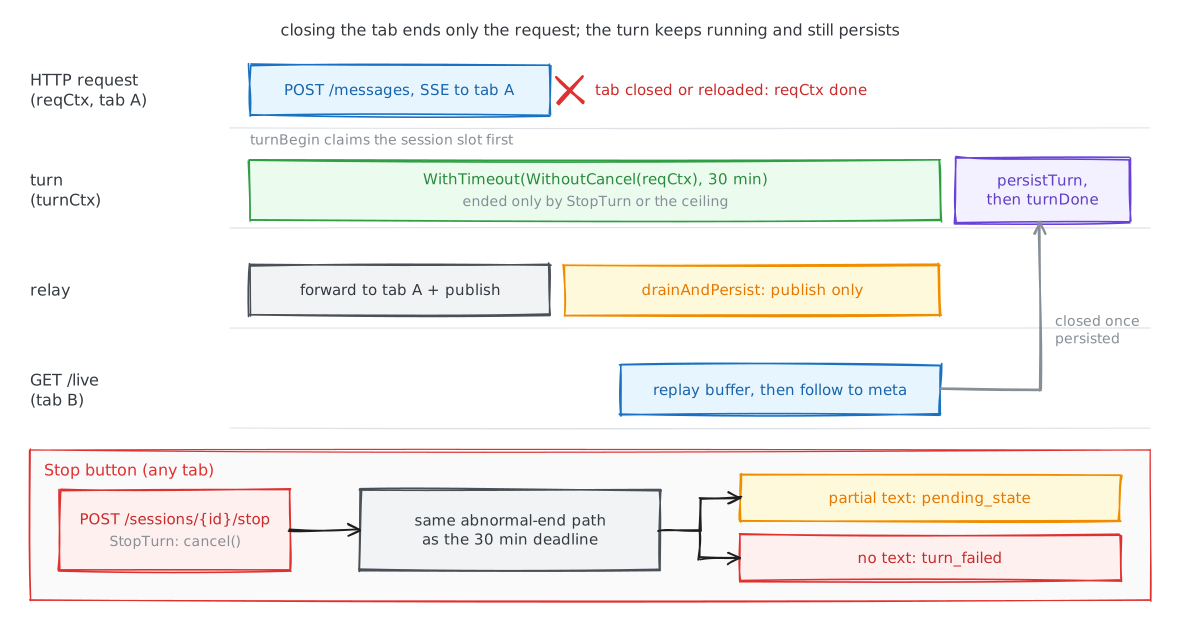
First, a turn belongs to the session, not to the request. Closing the tab ends the HTTP request, not the turn. Only the stop button or a 30-minute ceiling can.
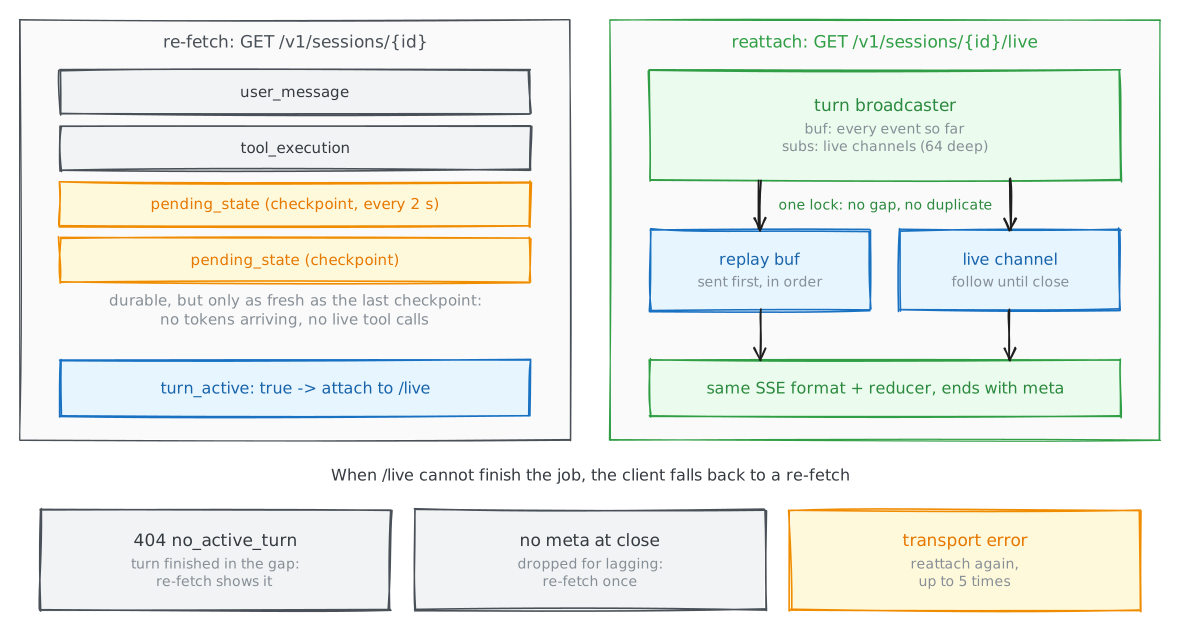
Second, a returning tab reattaches; it does not guess. A running turn buffers its events in memory. A new tab replays that buffer and follows the turn live, through the same code path as the tab that started it.
Third, every stream ends with exactly one terminal event. The rule holds at every hop from the provider to the browser, and a backstop in the persistence path covers any hop that still fails.
The problem
Why can’t a chat turn just be an HTTP request?
The obvious Go handler runs the whole turn on the request’s context, so everything stops when the client goes away. But I reload pages and my laptop sleeps. Each of those used to kill an answer seconds from finishing, and the session then showed a failure that was not one.
The opposite mistake is worse: a turn that ends with nothing recorded at all. The requirements:
| Requirement | What it means |
|---|---|
| Survives the client | A closed tab, reload or dropped connection never kills a turn |
| Stoppable | An explicit stop works from any tab |
| Watchable | Any tab can watch a running turn live |
| Exclusive | Two sends on one session never interleave in the event log |
| Always evidenced | A turn that ran leaves an answer, a partial, or a named failure |
Challenge 1: who owns a turn?
What should cancel a turn, if not the browser?
| Option | How it works | Why not (or why) |
|---|---|---|
| A. Request-scoped context | The turn runs on the request’s context | A reload or a dropped connection kills the turn |
| B. Job queue and worker | Persist a job, a worker runs it, clients poll | A broker and a second copy of state the event log already holds, for one user |
| C. Detached turn with its own context (chosen) | The turn runs in brain on a context the request cannot cancel, registered per session | No new infrastructure; the event log stays the only durable state |
I chose C. Brain builds the turn’s context with context.WithTimeout(context.WithoutCancel(reqCtx), 30*time.Minute). It keeps the request’s values (auth, trace) and drops its cancellation. The relay watches the request only to know whether this tab is still listening. When the tab goes, the relay switches to drainAndPersist: it consumes the turn to the end and persists it as if the client had stayed.
- Stop is explicit. Closing a tab used to double as a stop button, so a real one had to exist:
POST /v1/sessions/{id}/stopcalls the stored cancel function. The turn then exits through the same path as the deadline: partial text becomes apending_state, otherwise aturn_failedevent. - The ceiling must outlive the permission park. A turn can wait 10 minutes for my approval of a tool call. A
TURN_TIMEOUToverride exists for slow CPU-only backends, and values of 10 minutes or less are rejected. - Partials are checkpointed. The relay writes a
pending_stateevery 2 seconds while text grows, so even a killed brain loses little.
Challenge 2: how does a returning tab catch up?
Is the persisted transcript enough for a tab that opens mid-turn?
| Option | How it works | Why not (or why) |
|---|---|---|
| A. Re-fetch the transcript | Poll GET /v1/sessions/{id} until the turn completes | Only as fresh as the last checkpoint, with no live tokens or tool calls |
| B. Persist every token, tail the log | Write each chunk to session_events, stream from the database | Floods the append-only log with deltas both projections must ignore |
| C. In-memory replay buffer (chosen) | GET /v1/sessions/{id}/live replays the turn’s events so far, then follows it | No extra writes, same wire format as the original stream |
I chose C. Each running turn has a turn broadcaster: a buffer of every event so far plus a set of live subscriber channels. subscribe() takes the snapshot and registers the channel under one lock, so no event can fall into the gap between replay and live. The stream is identical to POST .../messages and ends with the same meta event, so the web client feeds both through one reducer.
- The registry is the truth.
turn_activeon the session endpoint is read from the broadcaster map, not a separate flag. The entry is removed only after the terminal persist is durable, soturn_active: falseguarantees a fetch sees the finished turn. - Slow watchers are cut loose. A subscriber more than 64 events behind is closed rather than allowed to stall the turn. It sees no
meta, so the client re-fetches once. - Re-fetch remains the fallback. A
404 no_active_turnmeans the turn just finished, so the client re-fetches. A transport error means it is probably still running, so the client reattaches, up to five times.
Challenge 3: what stops two turns on one session?
What happens when I double-click send, or two tabs send at once?
| Option | How it works | Why not (or why) |
|---|---|---|
| A. Database lock | A row or advisory lock per session | A second source of truth for “a turn is running” that can drift |
| B. Queue the second message | Run it after the current turn | The second send is usually an accident (a double-click or a racing retry), and a queue is more state to own |
| C. Exclusive claim, then 409 (chosen) | turnBegin registers the broadcaster or fails | The same map answers “is a turn running?” and “may I start one?” |
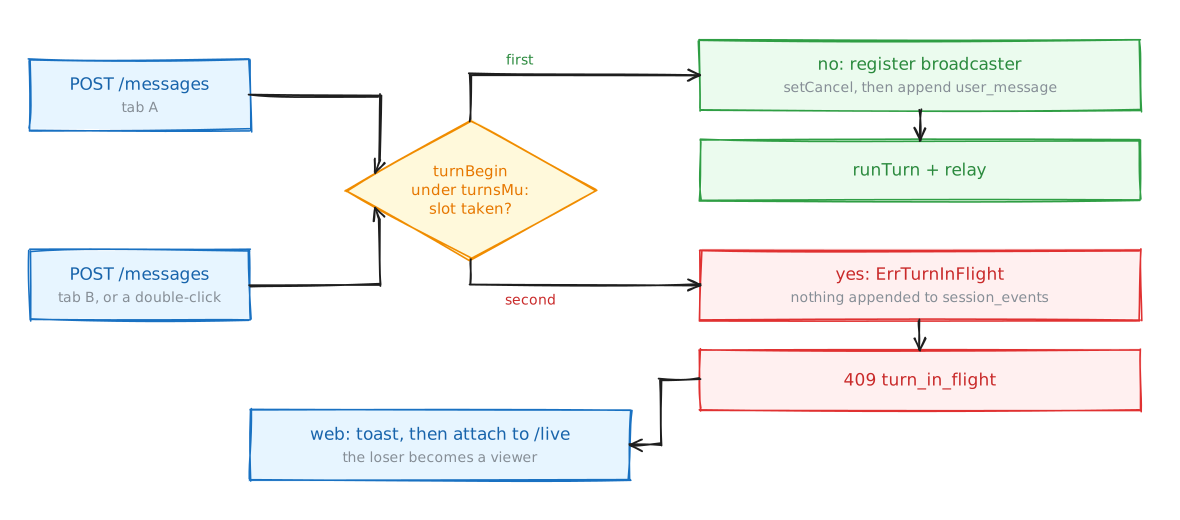
I chose C. turnBegin checks and inserts under one mutex. A loser gets ErrTurnInFlight, which the API maps to 409 turn_in_flight.
- Claim before the first append. The check runs before the
user_messageis written, so a loser never leaves a message with no turn behind it. - The loser becomes a viewer. The web client answers a 409 with a toast and an attach to
/live, so a double-click is harmless.
Challenge 4: how does every stream end exactly once?
Can the end of a turn be best-effort?
Every provider’s wire format is translated into one event vocabulary with a one-line contract: a stream ends with exactly one terminal event, done (possibly preceded by incomplete) or error, and the channel closes immediately after.
| Option | How it works | Why not (or why) |
|---|---|---|
| A. Trust each producer | Each layer sends its terminal if it can | Any one lost send erases the turn |
| B. Backstop only | Persistence synthesizes a failure when nothing arrives | A generic reason that hides which layer broke |
| C. Defend every hop, plus a backstop (chosen) | Each layer guarantees its terminal; persistence refuses to record nothing | Real reasons reach the user |
I chose C. The details that make each hop honest:
- Headers before the provider dial. Brain’s gateway client allows 30 seconds for response headers, and a cold-loading local model can be slower. The gateway writes
200and flushes before its first provider attempt; later failures, includingchain_exhausted, arrive as SSE error events. - Silence has a name. A provider that finishes with zero content is a failed attempt (
empty_output) that fails over to the next provider, and the ledger books it asincomplete, neverok. A completed turn with no text, reasoning or tool calls becomesturn_failedwithempty_response. The agent loop keeps anincompletesticky, so a laterdonecannot erase it. - Heartbeats. The chat stream and
/livewrite a: pingcomment every 20 seconds, so no proxy sees an idle connection.
What broke
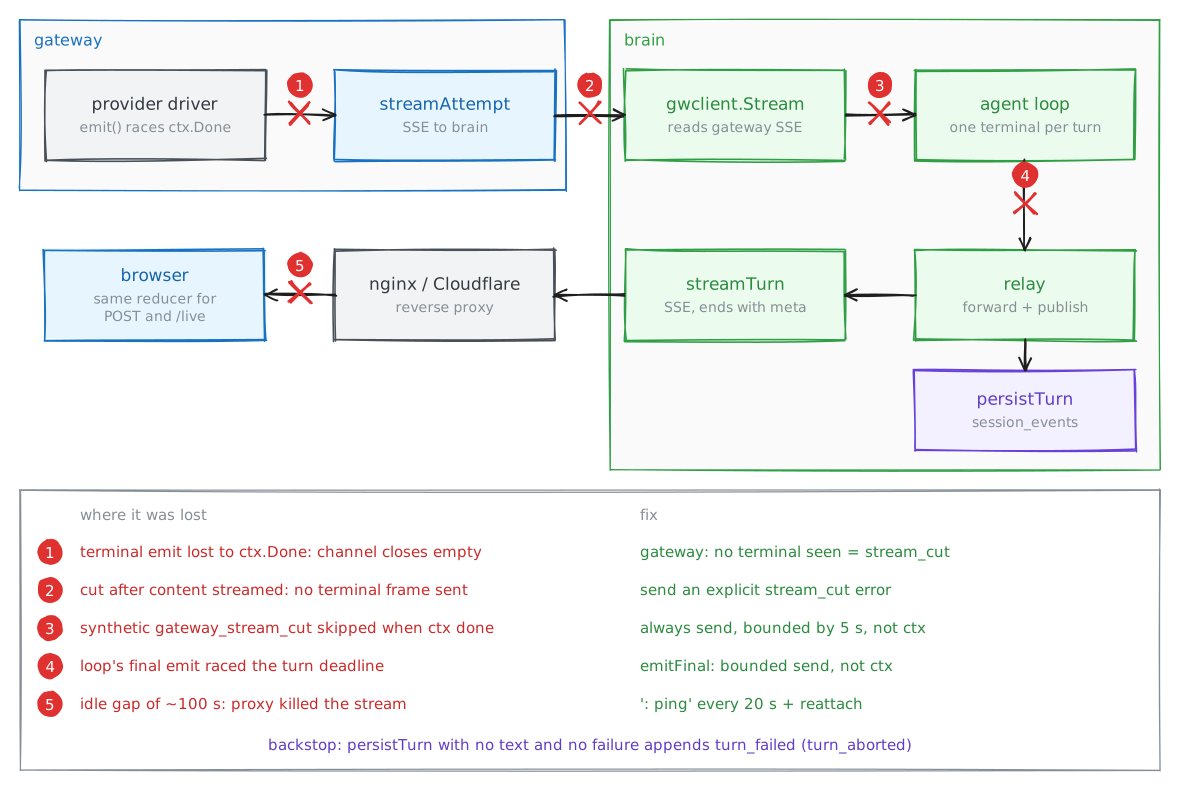
A turn of about thirty minutes against a slow model on a CPU-only box ended with nothing in session_events. Detached turns made long turns possible, and long turns exposed every weak hop. A proxy killed the connection after about 100 idle seconds. The provider driver’s final emit lost a race against ctx.Done() and closed its channel empty. The gateway sent no terminal after content had streamed. Brain’s gateway client skipped its synthetic gateway_stream_cut because the context was already done, and the agent loop’s final send raced the same deadline.
Three of the five came down to one pattern: select { case out <- ev: case <-ctx.Done(): } for an end-of-stream event. When the deadline fires as the terminal is sent, both cases are ready and Go picks one at random. The gateway now names a terminal-less close stream_cut, and brain sends terminals with a 5-second bound instead (emitFinal in the loop). Underneath, persistTurn turns “no text and no failure” into turn_failed with code turn_aborted. The lesson: racing cancellation is fine for progress events and wrong for the event that proves the work happened.
What’s next
Part 5 turns to what Timothy remembers afterwards: typed, staged memory and a knowledge base the model searches through a tool.